
INTERCULTURE COMMUNICATION AT WORK
Same Workplace. Different ways of seeing it.

Behind every interaction lie cultural expectations, experiences, and emotions.
Reduce misunderstandings. Communicate clearly. Work better together.
THE EVERYDAY MOMENTS THAT MATTER
A small misunderstanding can change the whole conversation.
Explore everyday workplace situations through different cultural lenses, then practise what to say and how to respond.
Do I trust you?

-
In multicultural teams, trust develops differently: in some contexts it grows quickly through informal interactions and personal sharing, while in others it is built slowly through consistent performance and reliability. This can lead to mismatched expectations about how professional relationships should evolve.
-
In some cultures, trust is primarily cognitive-based on competence, reliability, and results. In others, trust is more affective and relational, developed through personal connection, shared experiences, and informal interaction. What counts as “professional closeness” or “appropriate distance” varies significantly across contexts.
-
Trust is not built in one single way. It follows different cultural logics that shape what people consider credible, reliable, and close.
What Does Silence Mean?

-
In international meetings, some participants speak very little even when explicitly invited to contribute. Others tend to fill the silence quickly and may interpret quietness as a lack of preparation, disengagement, or low competence.
-
Silence can carry very different meanings depending on the cultural context. In high-context cultures (Hall), silence can mean thinking, respect, or careful listening. In low-context cultures, people expect more verbal participation. Power distance (Hofstede) also matters: in hierarchical settings, speaking up freely is less common.
-
Silence is not neutral; it has cultural meaning. If we don’t interpret it, we may think someone is not engaged, when actually it is a sign of respect and care.
Direct or Indirect Feedback?
-
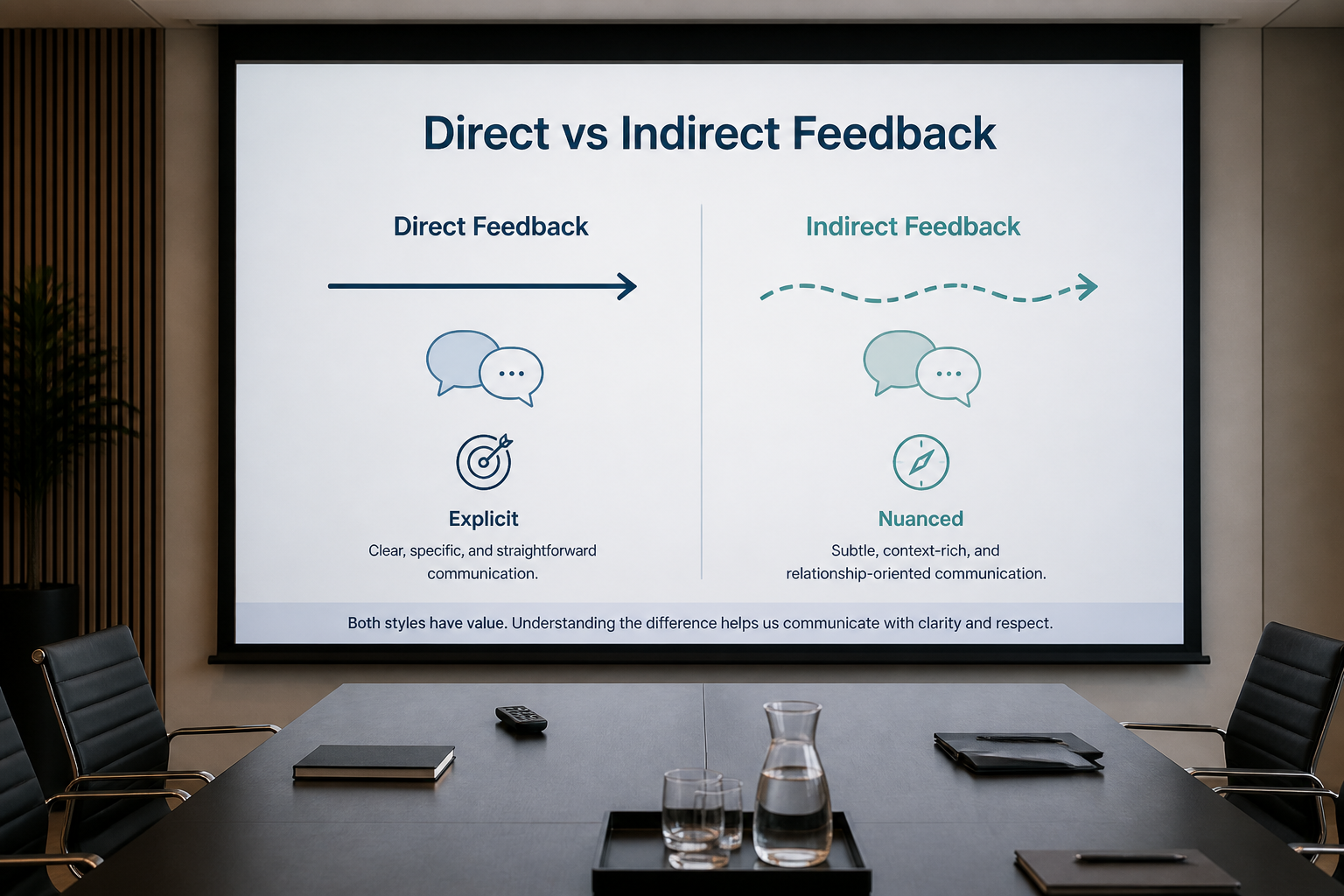
Within teams, feedback is sometimes delivered very directly (“this is incorrect”, “this needs to change”), while in other contexts it is softened, contextualized, or implied. This often leads to misunderstandings: some perceive direct feedback as harsh, while others find indirect feedback unclear or even unhelpful.
-
Low-context communication (explicit direct) focuses on clear, direct messages and keeps content separate from personal relationships. High-context communication (implicit contextual) hides feedback in social relationships, valuing harmony and implied meaning. In more collectivist cultures (Hofstede), avoiding conflict and saving face are important.
-
Feedback is not only about content, but about relational impact. The same message can be perceived as clarity or conflict depending on the cultural lens.
Would Your Team Follow You?

-
In some organizations, leaders make decisions in a centralized way and communicate them to the team. In others, leadership is more participative, expecting discussion and shared input. This creates uncertainty around how much employees are expected to contribute to decision-making.
-
Power distance (Hofstede) means how people see authority. In high power distance cultures, the boss decides and people follow. In low power distance cultures, the boss asks the team and decides together with them.
Trust in a leader can come from their position (because they are the manager) or from seeing that they are competent and consistent in daily work.
-
Leadership is not a universal behavior but a culturally shaped expectation of how authority and responsibility should be distributed.
WHAT MAKES THE DIFFERENCE
Practical Workshops
for multicultural teams, focusing on how communication, expectations, emotions, and cultural differences affect everyday teamwork.


-
This is not traditional team building. It is an interactive learning experience that combines engaging team activities with practical workplace examples to help participants recognise how culture shapes the way we communicate, give and receive feedback, manage time, and respond to conflict. Rather than focusing solely on theory, the workshop encourages active participation, reflection, and discussion in a dynamic and enjoyable environment. The result is greater cultural awareness, fewer misunderstandings, and stronger collaboration across multicultural teams.
-
Emotional intelligence starts with self-awareness. Before we can understand others, we need to recognise what we are feeling, why we are feeling it, and how those emotions influence the way we communicate and interpret the behaviour of others. This experiential workshop combines realistic workplace scenarios, practical activities, and guided reflection to help participants develop greater emotional awareness, empathy, and stronger interpersonal skills. By learning to pause before making assumptions, teams improve communication, reduce unnecessary conflict, and build more trusting and collaborative relationships across cultures.
-
There is no universal leadership style. What we perceive as effective leadership is often shaped by the cultural norms and organisational structures we have experienced throughout our lives. In some cultures, leadership is associated with hierarchy and clear authority; in others, it is built on equality, collaboration, and shared decision-making. Successfully adapting to different leadership expectations requires more than experience. It requires cultural awareness. Through practical workplace scenarios, role plays, interactive activities, and evidence-based insights, this workshop helps participants understand diverse leadership approaches, communicate more effectively across cultures, and lead with greater flexibility and confidence. The learning experience is highly interactive, engaging, and grounded in real-life workplace situations, making complex concepts accessible, memorable, and immediately relevant.
-
How do you express disagreement with a colleague? Do you openly say, "I don't agree"? Do you remain silent, hoping someone else will raise the issue? Or do you adapt, even when you believe a different solution would be better? There is no universal answer. Our response is often shaped by the culture in which we learned to communicate. Likewise, the way others interpret our disagreement is influenced by their own cultural background. What one person sees as honesty and constructive discussion, another may perceive as disrespect, personal criticism, or an open challenge. This interactive workshop helps participants recognise these cultural patterns through practical workplace examples, role plays, engaging activities, and guided discussion. Combining academic research with hands-on learning, participants develop the awareness and practical tools to handle disagreement more confidently, reduce misunderstandings, and foster healthier communication in multicultural teams.
-
How do you build trust? Do you trust people until they give you a reason not to, or do you need time before you feel confident relying on someone? Is it enough that a colleague is punctual, reliable, and consistently delivers high-quality work, or do you also need to know them personally before genuine trust develops? The answers often depend on culture. Some cultures build trust primarily through competence and reliability (cognitive trust), while others place greater value on personal relationships and emotional connection (affective trust). Understanding these different approaches is essential for building strong multicultural teams. Through practical workplace examples, interactive activities, and guided reflection, participants explore how trust is created, strengthened, and sometimes unintentionally damaged across cultures. Combining academic insights with engaging discussions and hands-on exercises, this workshop provides practical strategies for developing stronger relationships, improving collaboration, and creating a workplace where trust can grow across cultural boundaries.
-
Language is far more than a tool for communication. It shapes confidence, identity, professional credibility, and a sense of belonging. For professionals who move to a new country, learning the local language often means temporarily losing the ability to express their knowledge, personality, and expertise with the same confidence they had in their native language. This can lead to feelings of being deskilled, misunderstood, or less competent than they truly are. Avoiding the local language is not always a lack of motivation; it can also be an unconscious way of protecting one's professional identity and self-esteem.
At the same time, speaking a second language requires continuous mental effort. Even highly proficient English speakers may find it easier to express nuance, humour, emotions, and complex ideas in their native language. Informal moments, such as lunch breaks or social conversations, often become spaces where people naturally return to the language in which they feel most relaxed. Recognising these different perspectives helps reduce frustration, assumptions, and feelings of exclusion on both sides.
Through academic insights, real workplace examples, role plays, and interactive activities, participants explore how language influences inclusion, collaboration, and workplace dynamics beyond vocabulary alone. The workshop provides practical strategies for creating more linguistically inclusive environments while fostering empathy, mutual understanding, and realistic expectations for both international employees and local colleagues. Learning is practical, engaging, and directly connected to everyday workplace situations.
-
Why not combine enjoyment with purpose? Alongside the warmth, laughter, and playfulness that characterize the Christmas season, your team will take part in an engaging and thought-provoking workshop designed to foster cultural awareness and empathy.
Through interactive activities, reflection, and shared experiences, participants will gain a deeper understanding of different perspectives, communication styles, and cultural backgrounds. The result is not only an enjoyable and memorable julebord, but also a stronger, more connected, and more inclusive team.
-
Communication is about far more than the words we choose. Across cultures, people differ in how much they communicate explicitly (low-context communication) or rely on shared understanding, context, and implicit messages (high-context communication). When these styles meet, misunderstandings can easily arise, even when everyone is speaking the same language. What one person considers clear and efficient may be perceived by another as blunt or insensitive, while indirect communication may be interpreted as vague, passive, or lacking transparency.
Through academic insights, real workplace scenarios, interactive activities, and guided discussion, participants learn to recognise these communication patterns, understand the cultural assumptions behind them, and develop practical strategies for adapting their communication style. The workshop provides immediately applicable tools to reduce misunderstandings, strengthen collaboration, and build more effective multicultural teams.
-
Giving feedback is one of the most challenging aspects of working across cultures. What is considered clear, respectful, or constructive in one context may be interpreted very differently in another. Learn how cultural differences shape feedback styles and develop strategies for delivering feedback more effectively across cultures.
What keeps happening in your team?
Tell me about the situations you want to understand or change. We can find the right starting point together.