
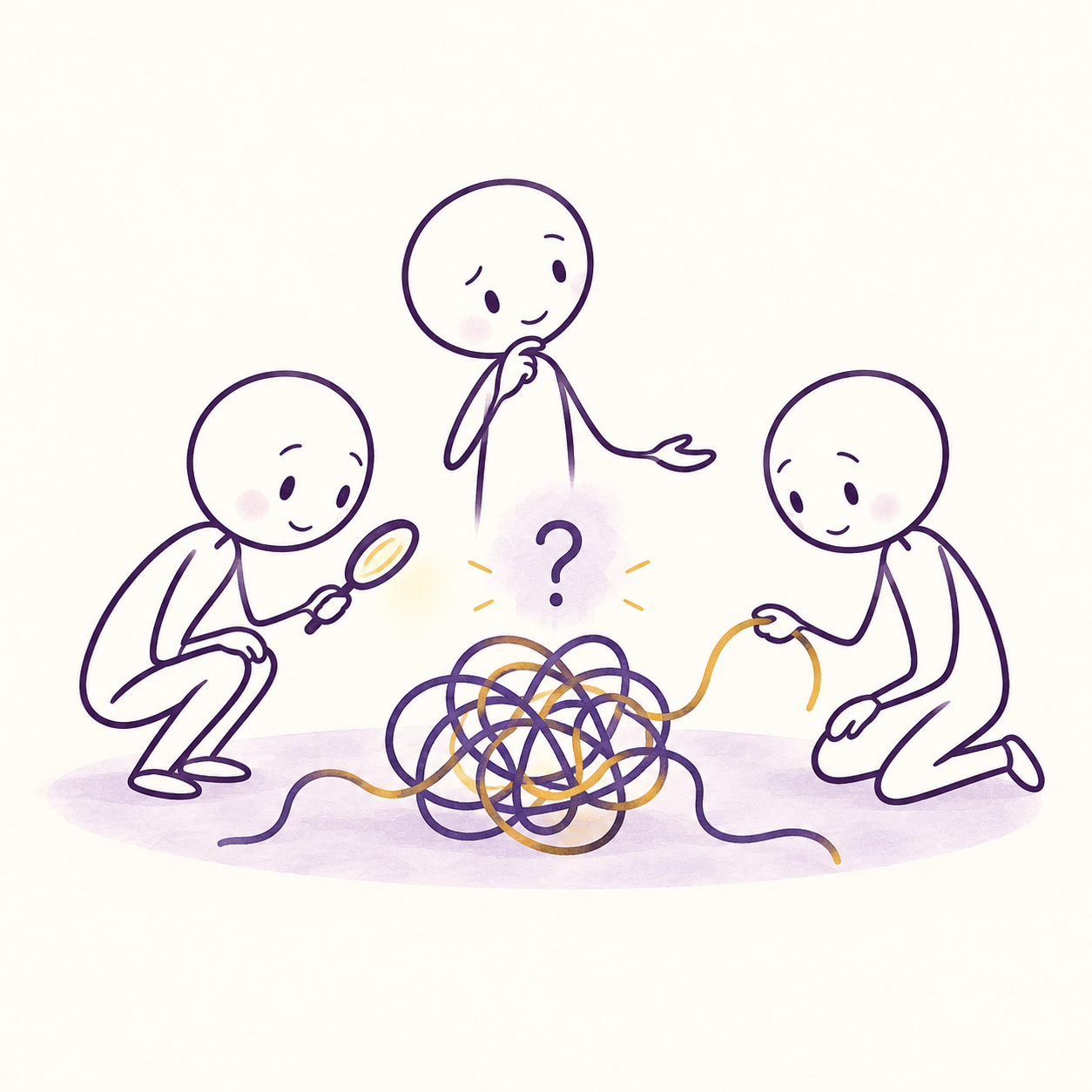
What’s Your Team’s Challenge?
What is your team’s real challenge?
Which language is mainly used in your team, and is it comfortable for everyone?
How is silence perceived? As an awkward gap that needs to be filled, or as a space where someone feels more comfortable speaking?
How many communication styles live within your team?
Do people address challenges directly or prefer a more indirect approach?
Is feedback best given openly, or with more nuance? How is feedback received, and how is it usually delivered?
Do challenges tend to be avoided, or are they faced head-on?
How does your team relate to time? Is it something flexible, or something that needs precision?
How aware is the team of stereotypes and the perceptions they shape?
What it enables
Every team operates with a set of visible and invisible communication patterns, cultural assumptions, and behavioural norms. When these are not aligned, misunderstandings, inefficiencies, and friction can emerge — often without being clearly identified.
This workshop helps make those dynamics visible, creating a shared understanding of how the team actually works.
Who it’s for
Multicultural and international teams experiencing collaboration challenges
Managers and team leaders seeking to improve team dynamics
HR and People & Culture professionals supporting organisational development
Teams working across languages, cultures, or hybrid environments
Key topics
Team communication patterns and hidden norms
Language comfort and linguistic inclusion in teams
Silence, participation, and speaking dynamics
Direct vs indirect communication styles
Feedback culture and emotional safety
Conflict avoidance vs direct confrontation
Time perception and work pacing in teams
Stereotypes, perceptions, and unconscious biases
Workshop format
This is a facilitated diagnostic and development intervention, tailored to the specific needs and dynamics of each team.
Rather than a standard training session, the workshop uses guided reflection, structured dialogue, and targeted questions to surface how the team actually communicates and collaborates in practice.
The format is fully flexible and can be adapted in depth, focus, and duration depending on organisational context and complexity.
The process typically includes facilitated group discussion, real-case exploration, and reflective exercises designed to make implicit team dynamics visible and discussable.
Duration
Fully flexible (typically 2.5 hours to half-day, or extended formats for deeper interventions)
Group size
Up to 15 participants (larger groups can be structured into sub-groups)
Expected outcomes
Participants will be able to:
Identify underlying communication patterns within the team
Recognise cultural and behavioural differences affecting collaboration
Increase awareness of how language, silence, and feedback are interpreted
Understand how assumptions and stereotypes influence teamwork
Develop shared strategies to improve communication and collaboration
Create a clearer foundation for team alignment and interaction
Closing note
This workshop is not a standard training session. It is a tailored diagnostic process designed to help teams understand themselves more clearly and work together more effectively.
What is your team’s real challenge?
Which language is mainly used in your team, and is it comfortable for everyone?
How is silence perceived? As an awkward gap that needs to be filled, or as a space where someone feels more comfortable speaking?
How many communication styles live within your team?
Do people address challenges directly or prefer a more indirect approach?
Is feedback best given openly, or with more nuance? How is feedback received, and how is it usually delivered?
Do challenges tend to be avoided, or are they faced head-on?
How does your team relate to time? Is it something flexible, or something that needs precision?
How aware is the team of stereotypes and the perceptions they shape?
What it enables
Every team operates with a set of visible and invisible communication patterns, cultural assumptions, and behavioural norms. When these are not aligned, misunderstandings, inefficiencies, and friction can emerge — often without being clearly identified.
This workshop helps make those dynamics visible, creating a shared understanding of how the team actually works.
Who it’s for
Multicultural and international teams experiencing collaboration challenges
Managers and team leaders seeking to improve team dynamics
HR and People & Culture professionals supporting organisational development
Teams working across languages, cultures, or hybrid environments
Key topics
Team communication patterns and hidden norms
Language comfort and linguistic inclusion in teams
Silence, participation, and speaking dynamics
Direct vs indirect communication styles
Feedback culture and emotional safety
Conflict avoidance vs direct confrontation
Time perception and work pacing in teams
Stereotypes, perceptions, and unconscious biases
Workshop format
This is a facilitated diagnostic and development intervention, tailored to the specific needs and dynamics of each team.
Rather than a standard training session, the workshop uses guided reflection, structured dialogue, and targeted questions to surface how the team actually communicates and collaborates in practice.
The format is fully flexible and can be adapted in depth, focus, and duration depending on organisational context and complexity.
The process typically includes facilitated group discussion, real-case exploration, and reflective exercises designed to make implicit team dynamics visible and discussable.
Duration
Fully flexible (typically 2.5 hours to half-day, or extended formats for deeper interventions)
Group size
Up to 15 participants (larger groups can be structured into sub-groups)
Expected outcomes
Participants will be able to:
Identify underlying communication patterns within the team
Recognise cultural and behavioural differences affecting collaboration
Increase awareness of how language, silence, and feedback are interpreted
Understand how assumptions and stereotypes influence teamwork
Develop shared strategies to improve communication and collaboration
Create a clearer foundation for team alignment and interaction
Closing note
This workshop is not a standard training session. It is a tailored diagnostic process designed to help teams understand themselves more clearly and work together more effectively.